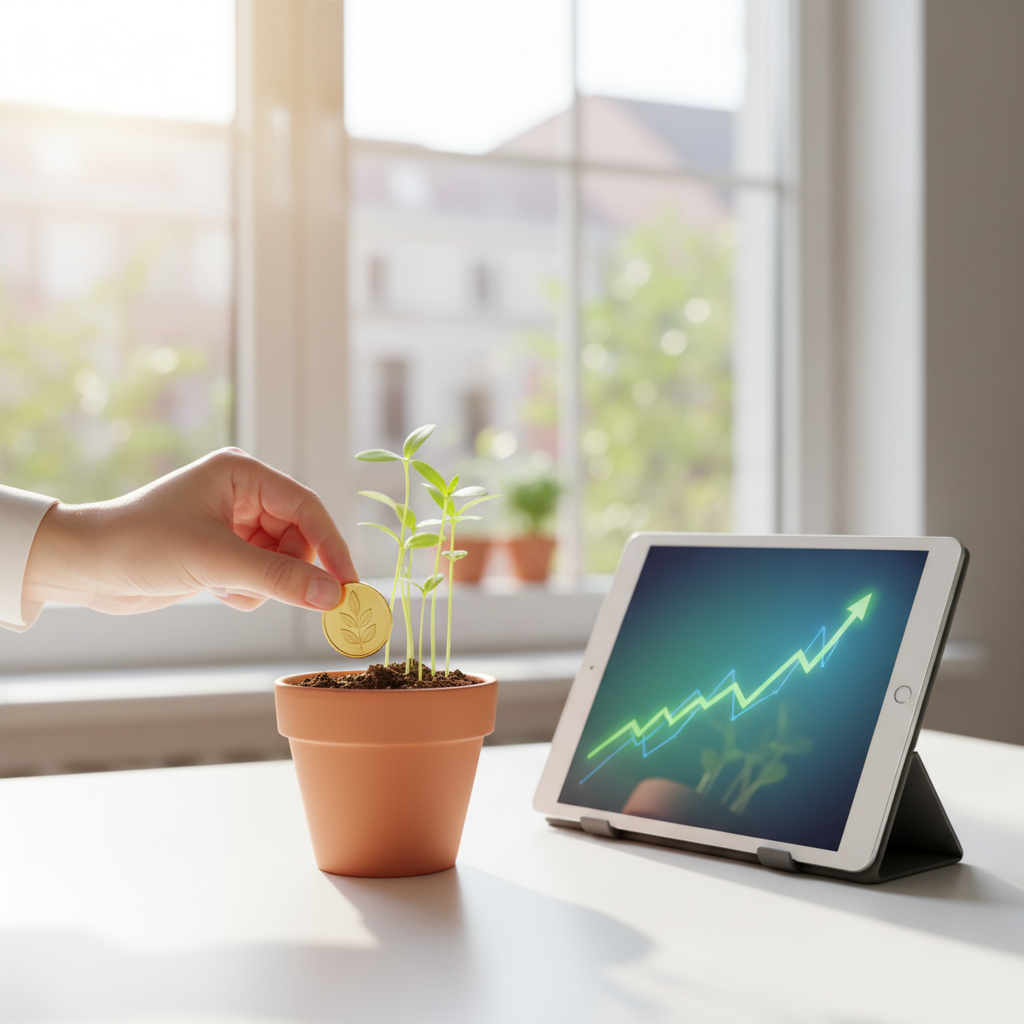
Your first $1,000 can feel too small to matter, especially when rent, mortgages and groceries are stretching household budgets. It still matters. Not because it will transform your life overnight, but because it can help you create a repeatable investing habit.
Before you invest it, though, make sure it is genuinely money you can leave alone. Investing works best when you can give it years, not months.


Start with the financial pressure in front of you
There is no prize for investing while expensive debt is quietly draining your cash. Mid-2026 data from Money.com.au puts average Australian credit-card balances at $3,635, while RBA data cited by Canstar puts the average card rate around 20.99% a year.
If you put $1,000 into an investment that rises 7% over a year, you might gain about $70 before tax. If you use that $1,000 to reduce a credit card charging 20.99%, you avoid roughly $210 of interest over a year, assuming the balance would otherwise stay there. That saving is certain; investment returns are not.
A sensible order of priorities is usually:
- Cover essentials and keep bills paid.
- Build a small emergency buffer, even $500 to $1,000 initially.
- Pay off credit cards, payday loans and other high-interest debt.
- Check whether extra mortgage repayments, an offset account or investing best fits your situation.
- Invest money you will not need for at least five years.
This is particularly relevant now. Finder reports that more than half of Australian mortgage holders spend over 30% of take-home pay on repayments, and Cotality put the national median weekly rent at a record $705 in July 2026. If your budget is already tight, cash savings may be more useful than an investment you could be forced to sell at the wrong time.


What an index fund actually does
An index fund aims to track a market index rather than trying to pick winning companies. For example, an Australian shares index fund may hold stakes in hundreds of companies listed on the ASX. A global index fund may hold companies across the US, Europe, Japan and other markets.
You can access index funds through managed funds or exchange-traded funds (ETFs). An ETF trades on the share market through a broker; a managed fund is usually bought directly from a fund provider or platform. Both can be low-cost, but their minimum investments, trading costs and tax administration can differ.
The appeal is diversification. If one company has a terrible year, it is only a small part of a broad fund. That does not stop the whole fund falling when markets fall, but it reduces the risk of one bad company doing severe damage to your savings.
For a first $1,000, simple can be better than clever. You do not need five funds to be diversified. One broad, low-cost Australian or global index fund — or one diversified fund that combines shares and bonds — can be enough to begin researching.

Fees are small numbers with a long tail
Fees are often shown as a percentage, which can make them seem harmless. They are not the only thing that matters, but they are one of the few things you can control.
Suppose two funds both earn 7% before fees over the long run. Fund A charges 0.20% a year, leaving 6.80%. Fund B charges 1.20%, leaving 5.80%. If you invest $1,000 and add $100 a month for 20 years, Fund A could grow to roughly $51,900. Fund B could be around $45,500. The exact outcome will vary, but the lesson is durable: a 1 percentage point annual fee gap can cost thousands over time.
Also check for brokerage, account fees, buy/sell spreads and platform charges. A $10 brokerage fee on a $100 purchase is a 10% upfront hit. If your platform charges per trade, it may make more sense to invest quarterly rather than every payday while you are starting out.
Do not choose solely on the lowest fee. Look at what the fund owns, how broadly it is diversified, how it handles currency exposure where relevant, and whether you understand it.

Use dollar-cost averaging to make consistency easier
Dollar-cost averaging means investing the same dollar amount at regular intervals: for example, $100 each month. When prices are lower, your $100 buys more units; when prices are higher, it buys fewer.
It does not guarantee a better return than investing a lump sum immediately. If markets rise steadily, investing all available money earlier often wins simply because more money is invested for longer. But regular investing can be easier emotionally and practically, especially when your cash flow arrives through regular pay.
An illustrative approach could be to keep $500 in a high-interest savings account as a starter buffer and invest the other $500 in a broad index fund. Then automate $50 or $100 after each payday, once high-interest debt is cleared. If income is uneven, choose a smaller amount you can sustain instead of setting a target that makes you scramble.

Know what you own, and expect rough patches
Before buying, read the fund's product disclosure statement or key investor information. Check its index, top holdings, fees, risks, distribution policy and tax treatment. If you are in Australia, keep records for capital gains tax and understand that distributions can be taxable even when automatically reinvested.
Most importantly, expect shares to fall sometimes — potentially sharply. A broad share fund is not a savings account, and its balance may be down when you look at it. That is why money for a bond, a car repair, an upcoming move or next year's holiday generally does not belong in shares.
Your first $1,000 does not need to prove that you are brilliant at investing. It only needs to start a process you understand: protect your basics, clear costly debt, choose a diversified low-fee option, and contribute regularly when you can. Small, calm decisions made for years are far more powerful than a perfect first purchase.
This article is general information only and not personal financial advice.